Beyond Maintenance: The Growth Evolution of TPM Providers. Part 2
12 May 2026 - 4 Minute Read
Transitioning from TPM Sales to Managed Services Sales
The Third-Party Maintenance (TPM) market has changed significantly over the past decade.
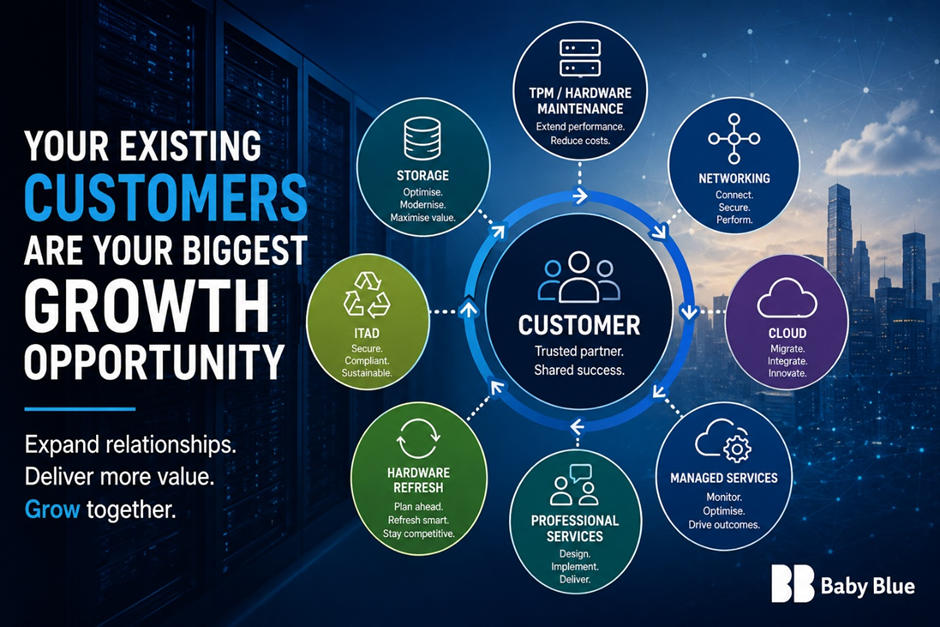
What was once largely a break/fix and support-driven industry has evolved into something far broader. Today, many TPM providers also deliver:
- IT Asset Disposition (ITAD)
- Hardware upgrades and refresh services
- Professional services
- Managed infrastructure support
- Hosting and cloud services
- Monitoring and operational management
This evolution is creating major growth opportunities for providers willing to adapt.
However, many businesses underestimate one critical reality: expanding the service portfolio is only part of the challenge. The sales model must evolve as well.
Maintenance Customers Can Become Much More Valuable
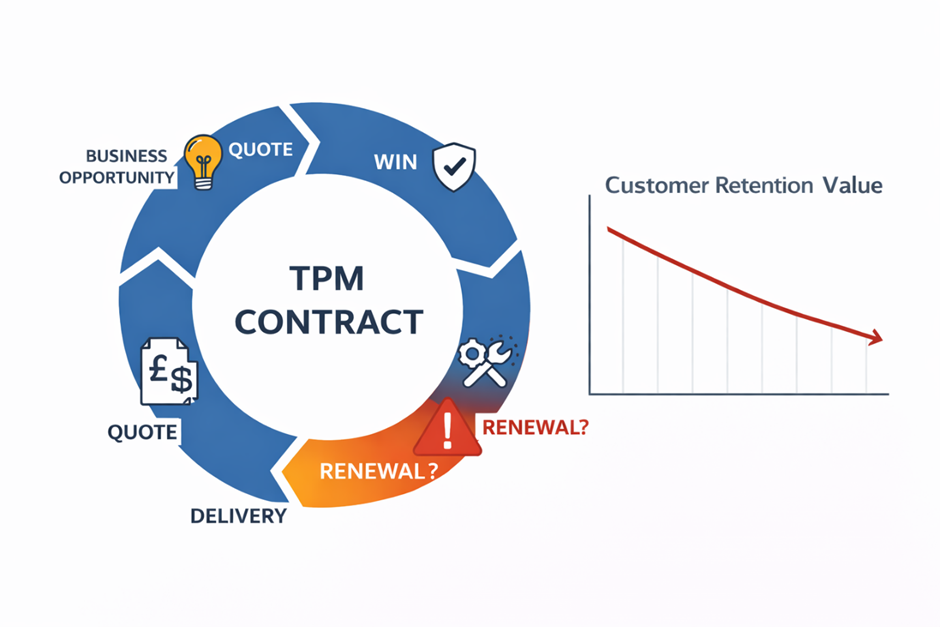
Traditional TPM contracts often represent only a small percentage of the potential value within a customer relationship.
A customer purchasing hardware maintenance today may also require:
- Operational management
- Infrastructure monitoring
- Backup services
- Platform upgrades
- Cloud migration support
- Professional consultancy
- Hosting or managed services
For many providers, successfully moving a customer from maintenance-only services into managed services can increase revenue from that single client by ten times or more.
The opportunity is significant.
But achieving this transformation requires a completely different commercial approach.
Selling Managed Services Is Not the Same as Selling TPM
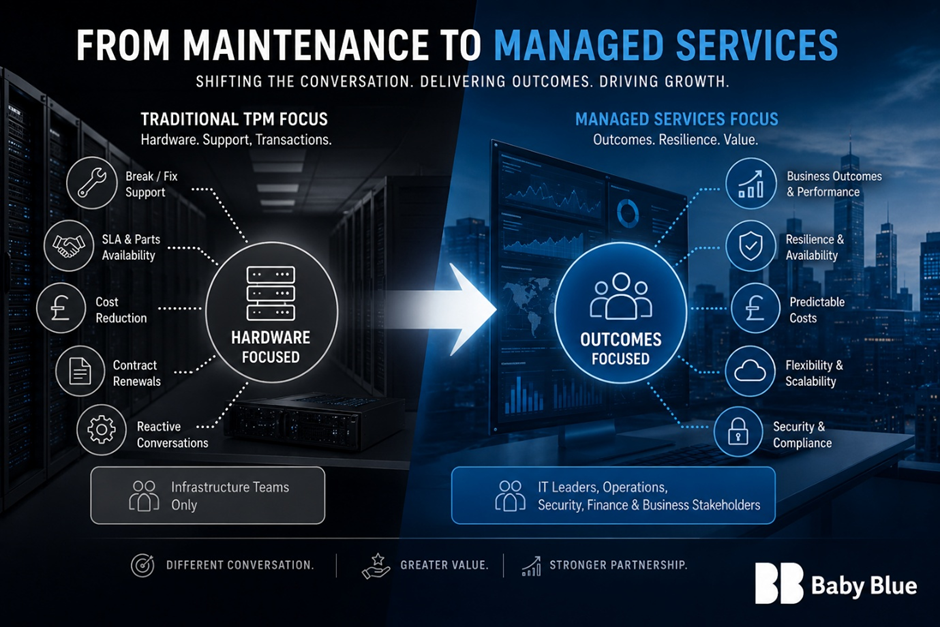
Traditional TPM sales are typically operational and transactional.
Conversations are often focused on:
- Hardware support
- SLA performance
- Parts availability
- Cost reduction
- Contract renewals
- Break/fix capability
Managed services discussions operate at a very different level.
The conversation moves away from the hardware itself and towards the business outcomes the infrastructure supports:
- Application availability
- Operational resilience
- User experience
- Compliance and security
- Resource flexibility
- Cost predictability
- Business continuity
This changes not only the value proposition, but also the buying stakeholders involved in the decision-making process.
Instead of purely infrastructure teams, discussions increasingly involve:
- IT leadership
- Operations teams
- Security and compliance stakeholders
- Finance
- Senior business decision makers
Many TPM providers struggle at this stage because they attempt to apply traditional maintenance sales methods to managed service opportunities.
The result is often wasted time, poor conversion rates, and frustration on both sides.
Sales Teams Must Evolve Alongside the Business
One of the biggest mistakes businesses make is assuming successful TPM salespeople can instantly transition into managed services sales without support or development.
The transition absolutely can happen but it takes time, patience, and investment.
Selling managed services requires different skills:
- Outcome-led conversations
- Business value positioning
- Strategic account development
- Multi-stakeholder engagement
- Consultative selling
- Long-term value creation
Sales teams need help moving away from purely transactional hardware discussions towards broader business conversations.
That journey requires:
- Coaching
- Enablement
- Leadership support
- Process evolution
- Patience from the business
The strongest transformations happen when organisations recognise this is a long-term capability shift rather than an overnight change.
The Most Successful TPM Providers Sell Outcomes, Not Hardware
The providers making the most successful transition into managed services are usually the ones that stop leading conversations with hardware and start leading conversations with operational outcomes.
Customers rarely buy managed services because they want another supplier looking after infrastructure.
They buy managed services because they want:
- Reduced operational burden
- Better availability
- Predictable costs
- Access to specialist skills
- Improved resilience
- Faster response to business demands
- Greater flexibility
This requires sales teams to engage differently.
The discussion must evolve from:
“What hardware do you have?”
to:
“What business challenges are you trying to solve?”
That change sounds simple, but for many TPM organisations it represents a fundamental shift in sales culture.
TPM Businesses Must Decide What They Want to Become
The market is increasingly rewarding providers that move beyond pure maintenance into broader operational and managed service offerings.
Customers are looking for:
- Fewer suppliers
- More operational support
- Greater flexibility
- Better commercial alignment
- Strategic technology partners
TPM providers are often extremely well-positioned to deliver this because they already have:
- Trusted customer relationships
- Infrastructure expertise
- Multi-vendor capability
- Operational credibility
The challenge is evolving the organisation, sales model, and customer engagement approach to support that wider proposition.
Transformation Requires Strategy, Not Just Services
Adding managed services to a website does not create a managed services business.
Successful transformation requires alignment across:
- Sales strategy
- Customer engagement
- Service capability
- Operational delivery
- Commercial positioning
- Leadership vision
At Baby Blue IT Consulting, we have worked with businesses successfully transitioning from TPM-focused sales models into broader managed services and cloud-led organisations.
The opportunity is substantial, but businesses that succeed are usually the ones that recognise the transformation involves far more than simply adding new services.
It requires evolving how the business thinks, engages customers, and sells value.
If you missed Part 1, click here to read it.
About the Author

Chris Smith
Chris Smith is a Non-Executive Director and commercial advisor with over 30 years’ experience in IT services across managed services (MSP) and third-party maintenance (TPM). With a background in IBM hardware maintenance, he progressed from field engineer to Sales & Marketing Director, helping to create the foundations of Blue Chip Cloud, which became the largest IBM Power Cloud globally at the time. He played a key role in the sale of Blue Chip in 2021 and subsequently led commercial growth and integration initiatives within Service Express, including delivering significant managed services growth and strengthening revenue predictability. Chris now works with private equity-backed, investor-led and founder-owned IT services businesses, supporting growth, commercial strategy, integration and exit readiness. He is particularly focused on helping organisations improve revenue quality, margin discipline and scalable go-to-market execution across MSP and TPM models.
LinkedIn