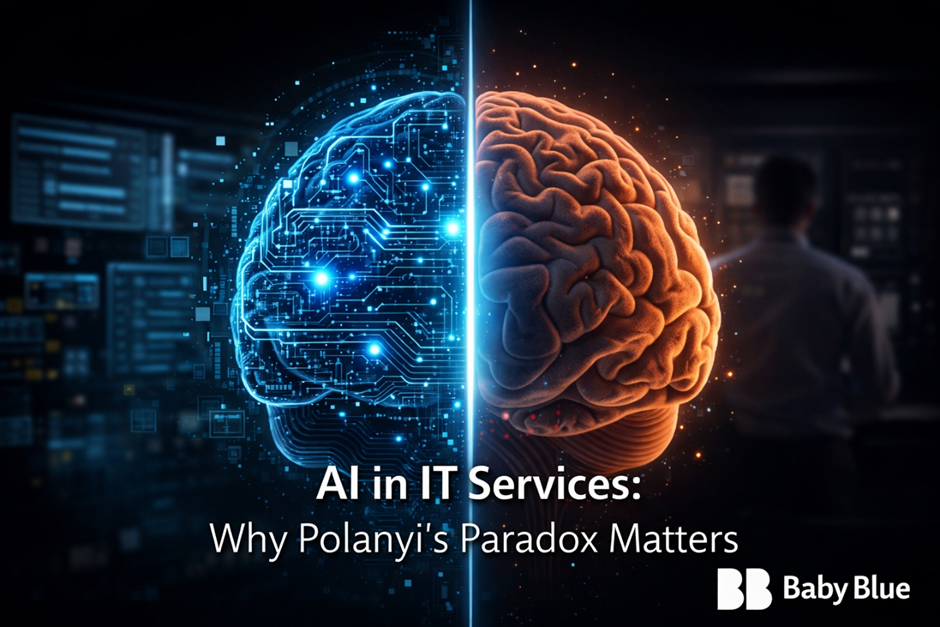
AI in IT Services: What Happens When Knowledge Scales but Judgement Doesn’t
19 March 2026 - 4 Minute Read
Over the past few years, artificial intelligence, specifically Large Language Models (LLMs), has consumed more written knowledge than any human ever could.
Modern models are trained on trillions of tokens, representing a significant proportion of the written internet. Every knowledge base article, support ticket, technical manual, and forum discussion has, in effect, been absorbed into systems that can now:
- Answer questions
- Diagnose issues
- Generate solutions
- Interact with customers
At scale.
So what does this actually mean?
In simple terms:
AI has already read more than any individual or organisation ever could.
And that capability is now being deployed rapidly across:
- IT service desks
- Managed services
- Infrastructure support
- Customer service operations
The obvious conclusion and why it’s wrong
The natural assumption is:
“If AI has read everything, it should be able to solve everything.”
This thinking is driving widespread adoption:
- AI agents replacing Level 1 support
- Automated triage and ticket resolution
- Self-healing infrastructure
- Near-instant customer responses
On the surface, it looks like IT service delivery has been solved.
But what are we actually dealing with?
At its core, most of this technology is:
A highly sophisticated chatbot.
That may sound reductive but it’s an important reality.
Modern AI systems:
- Take an input
- Process it against learned data
- Generate a response that appears intelligent
They are flexible, fast, and increasingly accurate.
But fundamentally:
They are predicting responses based on patterns not applying real-world judgement.
And that distinction matters.
The gap between knowledge and understanding
There is a fundamental flaw in the “AI has read everything” argument:
Not all knowledge exists in written form.
This is where Polanyi's paradox becomes critical.
LLMs are trained on what has been written and codified. But in IT services, particularly complex environments, that’s only part of the story.
Some of the most valuable expertise is:
- Experience-based
- Contextual
- Situational
- Difficult to fully document
An experienced engineer doesn’t just follow a runbook. They interpret signals, make judgement calls, and understand business impact, not just technical symptoms.
That capability isn’t fully captured in data.
What this means for IT service delivery
1. Automation will dominate the obvious
AI will continue to transform:
- First-line support
- Repetitive incidents
- Known error resolution
- Standard service requests
This is inevitable.
2. Complexity becomes more visible
As AI removes routine work, what remains are:
- Edge cases
- High-impact failures
- Ambiguous situations
Problems that don’t follow patterns, or don’t have documented solutions.
3. Customer care becomes more human
When things go wrong, customers don’t want:
- A chatbot
- A script
- A generic response
They want:
- Confidence
- Ownership
- Judgement
They want someone who understands business impact, not just system output.
The real shift: from knowledge to judgement
We are moving from:
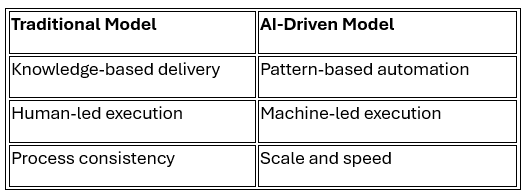
To a new model:
Automation handles knowledge.
Humans deliver judgement.
The risk for service providers
For managed service providers and TPM organisations, this creates a divide:
At the low end:
- Services become commoditised
- Pricing pressure increases
- Differentiation reduces
At the high end:
- Expertise becomes more valuable
- Trust becomes a differentiator
- Experience drives outcomes
The strategic takeaway
AI is not replacing IT service delivery.
It is redefining where value sits.
The more AI absorbs the written world,
the more valuable the unwritten expertise becomes.
For organisations consuming IT services, the risk is not that AI isn’t powerful, but that its limits are misunderstood.
AI will:
- Handle routine tasks
- Improve speed and efficiency
- Reduce cost in predictable areas
But it will not:
- Replace judgement in complex environments
- Understand business context in full
- Take ownership when outcomes matter
A note of caution
As AI adoption accelerates, so will the promises:
- Faster resolution
- Lower cost
- Fully automated support
Many of these will be partially true.
But the critical question is:
Where does AI stop and who takes over when it does?
Because that boundary is where:
- Risk increases
- Customer experience is defined
- Real value is delivered
Where Baby Blue fits
At Baby Blue, we see AI as an accelerator not a replacement.
The organisations that succeed will:
- Automate the obvious
- Retain expertise where judgement is required
- Design services around outcomes, not just efficiency
The goal isn’t to replace people with AI, it’s to understand where AI ends and where expertise must begin.
If you’re assessing how AI should be applied across your IT estate, whether in maintenance, managed services, or customer support, we can help you define that boundary.
About the Author

Chris Smith
Chris Smith is a Non-Executive Director and commercial advisor with over 30 years’ experience in IT services across managed services (MSP) and third-party maintenance (TPM). With a background in IBM hardware maintenance, he progressed from field engineer to Sales & Marketing Director, helping to create the foundations of Blue Chip Cloud, which became the largest IBM Power Cloud globally at the time. He played a key role in the sale of Blue Chip in 2021 and subsequently led commercial growth and integration initiatives within Service Express, including delivering significant managed services growth and strengthening revenue predictability. Chris now works with private equity-backed, investor-led and founder-owned IT services businesses, supporting growth, commercial strategy, integration and exit readiness. He is particularly focused on helping organisations improve revenue quality, margin discipline and scalable go-to-market execution across MSP and TPM models.
LinkedIn