IT Maintenance Options Explained: OEM, TPM or Time & Materials?
22 January 2026 - 4 Minute Read
When it comes to maintaining IT infrastructure, servers, storage and network equipment, most businesses are presented with a single option:
Whatever the supplier sells.
Manufacturers promote OEM support.
Third-party maintainers sell TPM contracts.
At Baby Blue IT, we take a different approach.
We provide all three support models:
- Genuine OEM Support
- Third-Party Maintenance (TPM)
- Time & Materials (T&M)
This allows our customers to weigh up cost versus risk and choose the level of cover that fits their business, not someone else’s sales strategy.
The Three IT Maintenance Models Explained
1. OEM (Manufacturer) Support
Best for: Businesses that need access to firmware, patches and software updates
Original Equipment Manufacturers (OEMs) are the only providers that can supply:
- Firmware updates
- Security patches
- Microcode and software fixes
- Official compliance support
If your business operates in a regulated environment or requires continued access to vendor updates, OEM support is essential.
What you gain:
- Full access to patches and updates
- Vendor-backed compliance
- Direct manufacturer support
What you lose:
- The highest support costs
- Limited flexibility
- Pressure to upgrade hardware
OEM pricing is typically far higher than the real cost of delivery, as manufacturers use maintenance as a way to encourage hardware refresh projects.
2. Third-Party Maintenance (TPM)
Best for: Older equipment where same-day fix SLAs are required
Third-Party Maintainers specialise in supporting out-of-warranty equipment and typically offer:
- Same-day or 4-hour fix SLAs
- On-site engineering
- Multi-vendor support
TPM contracts usually cost around 50% less than OEM, but still carry high margins.
What you gain:
- Fast response times
- Strong SLAs
- Lower cost than OEM
- Continued use of legacy hardware
What you lose:
- No access to OEM firmware or patches
- Annual contract commitment
- Still paying for cover you may never use
TPM is ideal when uptime is critical and equipment is ageing.
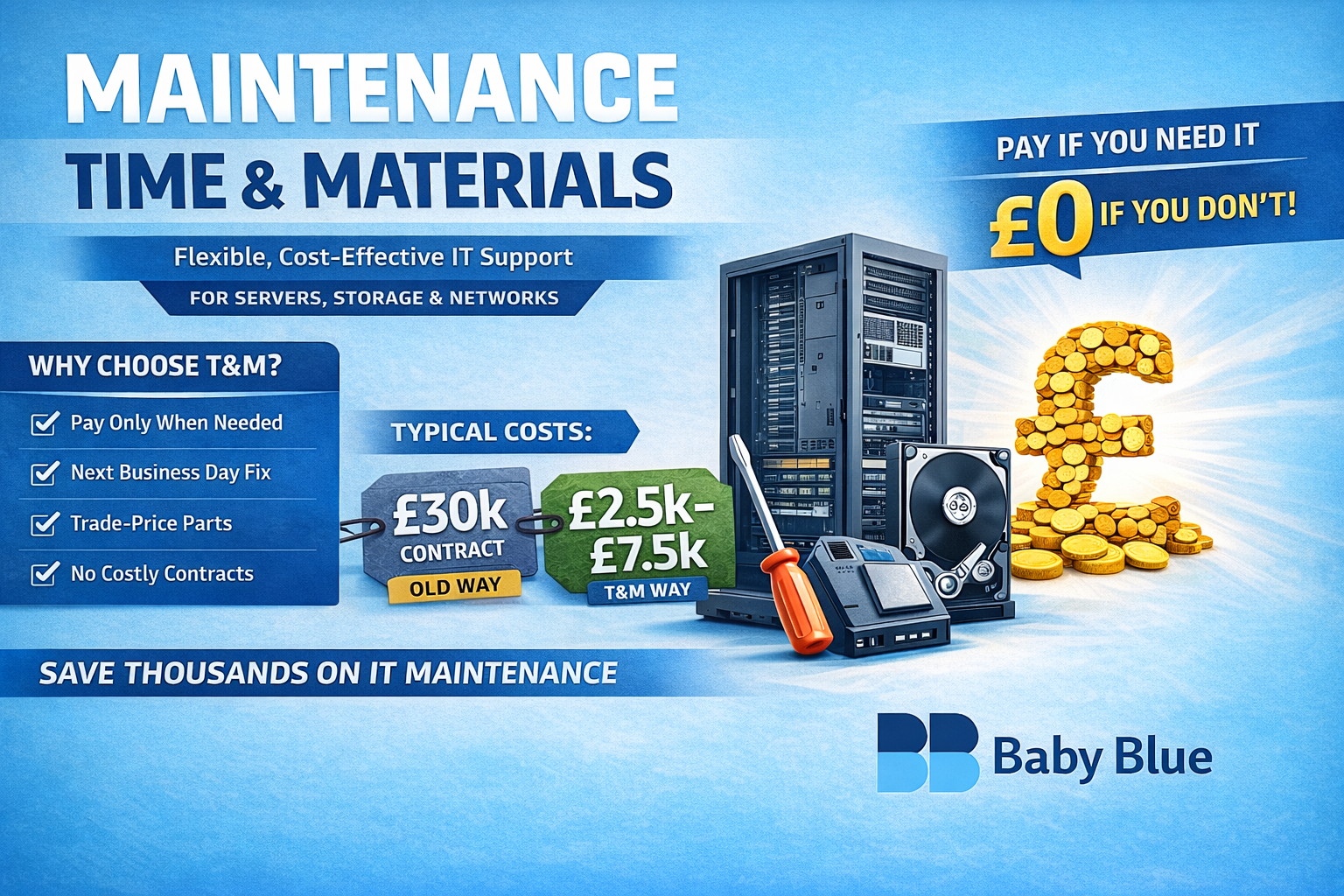
3. Time & Materials (T&M)
Best for: Cost-focused businesses that can accept next-business-day fixes
Time & Materials is the most flexible and cost-effective maintenance model.
Instead of paying a large annual contract, you only pay:
- When a part fails
- If you need an engineer
If nothing breaks?
You pay nothing.
What you gain:
- Huge cost savings
- No fixed annual fees
- Pay only when needed
- Trade-price parts
- Flexible engineering support
What you lose:
- Same-day response
- Guaranteed immediate fixes
For many modern environments, this trade-off makes perfect sense.
Why T&M Works So Well in Modern IT Environments
Today’s infrastructure is:
- Highly reliable
- Built with redundancy
- Virtualised
- Clustered for resilience
In most cases:
- A failed server doesn’t stop applications
- Storage has dual controllers
- Network devices have failover
- Workloads keep running
Fault rates are very low, and when issues occur, systems are designed to stay operational.
That’s why paying large annual maintenance fees “just in case” is often unnecessary.
How Time & Materials Works in Practice
With Baby Blue IT’s T&M support, customers receive:
- Next Business Day Fix SLA
- Trade-price parts + ~25%
- Optional engineer support (£150/hour)
- Multi-vendor coverage
Typical part costs:
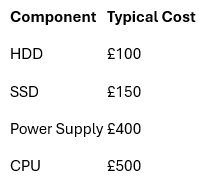
Most modern hardware uses CRUs (Customer Replaceable Units), so many parts can be swapped in-house without specialist engineers.
If required, Baby Blue can dispatch an engineer but most customers only need very few call-outs per year.
The Real Cost Comparison
For a typical UK business running:
- 20 servers
- 2 mid-range storage arrays
- 2 fibre switches
Annual support costs look like this:
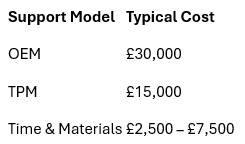
That’s up to 90% cheaper than OEM support.
Why Baby Blue Is Different
Most providers only sell their own model:
- OEMs push OEM support
- TPMs push TPM contracts
Baby Blue provides all three:
- OEM: when patches and compliance matter
- TPM: when fast SLAs are essential
- T&M: when cost efficiency is the priority
We help customers:
- Compare options
- Understand the risks
- Balance uptime vs cost
- Build a mixed support strategy
Many of our clients use:
- OEM support on critical systems
- TPM on legacy platforms
- T&M on non-critical infrastructure
This blended approach delivers maximum value.
Final Thoughts
OEM support offers compliance.
TPM offers fast response.
Time & Materials offers value.
With Baby Blue IT, you don’t have to choose blindly, you get clear options, honest guidance, and full control over your maintenance strategy.
If your infrastructure is stable, resilient and well-designed, Time & Materials could save your business tens of thousands of pounds every year.
About the Author

Will Nicholls
Will Nicholls is an industry recognised expert in the field of Hardware & Software Maintenance services especially around all IBM platforms. Will has worked in this field as a salesman for over 25 years and in his time has won some of the largest third party maintenance contracts many of which, due to his passion for account management, stayed with him for multiple years. Will is known for his innovation, bringing new, highly profitable services to the organisations he worked for. Will is now responsible all things maintenance related and making sure that we always do the right thing for the Customer.
LinkedIn