The AI GPU Gold Rush
18 May 2026 - 6 Minute Read
Are We Watching the Biggest Infrastructure Sales Cycle Since the Mainframe Era?
The technology industry is in the middle of an AI infrastructure feeding frenzy.
Hyperscalers are buying GPUs at record levels. Universities, governments, research labs, pharmaceutical companies, banks, and enterprises wanting sovereign AI capability are all scrambling for compute capacity.
Demand currently exceeds supply, and the winners are obvious:
- GPU manufacturers
- Memory manufacturers
- Data centre builders
- Power and cooling vendors
- Infrastructure investors
But beneath the hype sits a question many seasoned mainframe professionals will immediately recognise:
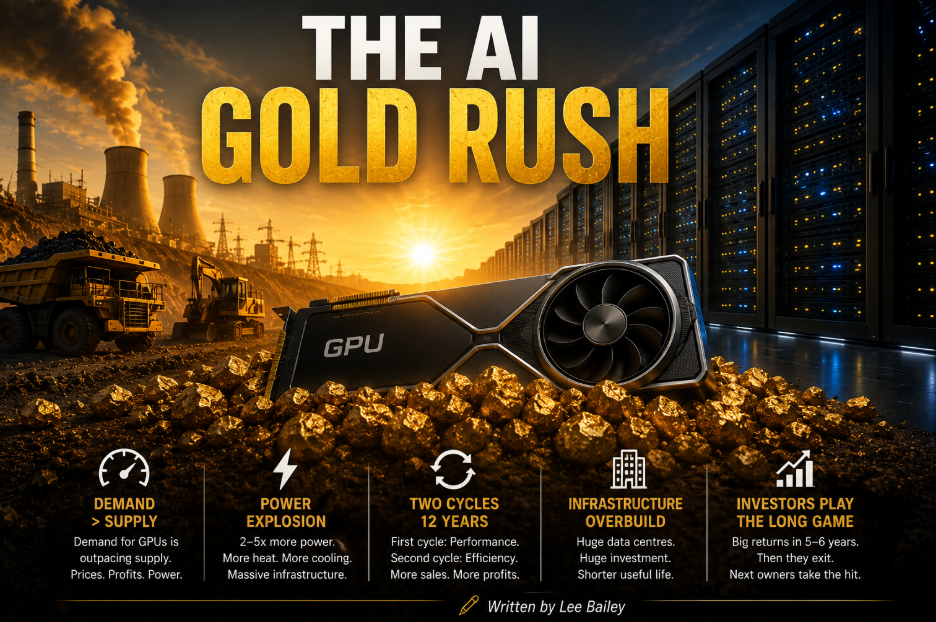
Are we witnessing genuine long-term infrastructure demand or the opening phase of a carefully managed 12-year sales cycle?
Because if you step back and look at the economics, the current AI boom starts to look remarkably familiar.
Mainframe Professionals Have Seen This Movie Before
Anyone who has spent decades around enterprise infrastructure understands one simple truth: Technology vendors do not simply sell products, they sell lifecycle dependency.
The current GPU market has all the hallmarks of a classic two-stage infrastructure cycle:
- Performance-driven expansion
- Efficiency-driven refresh
Right now, we are firmly in stage one.
The market is buying raw AI processing power at almost any cost. Operational efficiency has become secondary to acquisition speed.
That is exactly why GPU vendors are currently enjoying extraordinary margins.
The Dirty Secret of AI Infrastructure: Power
For years, enterprise IT had been moving in the right direction: servers became denser, virtualisation reduced footprint, flash storage replaced huge spinning-disk arrays and modern systems delivered dramatically better compute-per-watt ratios.
Entire racks of legacy storage from IBM, EMC and other enterprise vendors were replaced with compact flash systems consuming a fraction of the power and cooling.
Data centres were becoming more efficient every year.
Then AI arrived…
Installing high-density GPU configurations into modern servers and power consumption can increase two, three, even five times compared to traditional enterprise compute environments, and power is only half the story.
Every watt consumed becomes heat.
Every unit of heat requires cooling.
Every cooling system requires more power infrastructure.
In many large-scale data centres, particularly in warmer climates, cooling power consumption approaches the same level as compute power itself.
Add in:
- UPS inefficiencies
- AC/DC conversion losses
- Redundant power architectures
- High-density rack cooling
- Generator capacity requirements
…and suddenly the AI revolution starts looking less like a compute story and more like an energy crisis wearing a software badge.
Why GPU Vendors May Not Want Maximum Efficiency Yet
This is where the conversation becomes uncomfortable.
The industry narrative today focuses entirely on:
- More performance
- Larger models
- Faster training
- Bigger clusters
But what happens around 2031 or 2032 when much of the developed world already has substantial AI compute capacity installed?
At some point, the market inevitably slows.
And that creates a problem for GPU manufacturers and their shareholders:
How do you maintain explosive growth once the market becomes saturated?
The answer may already be obvious: you launch a second replacement cycle based on energy efficiency.
The Second GPU Gold Rush
The likely next chapter is easy to predict.
Between now and roughly 2032:
- Companies massively overbuild GPU capacity
- Data centres are constructed around extreme power density
- Cooling infrastructure explodes
- Operational costs soar
- Energy consumption becomes politically and economically sensitive
Then comes phase two.
GPU vendors release dramatically more energy-efficient AI accelerators capable of delivering similar or better processing capability at a fraction of the power consumption.
The sales pitch changes overnight:
- Lower operational expenditure
- Lower cooling costs
- Reduced rack density
- Improved sustainability targets
- Better compute-per-watt economics
And suddenly the industry gets another five-to-six-year refresh cycle.
Mainframe professionals understand this model instinctively because enterprise infrastructure has operated this way for decades:
- First sell performance
- Then sell consolidation
- Then sell efficiency
- Then sell modernisation
The AI GPU market may simply be accelerating that traditional enterprise cycle.
The Bigger Risk: Overbuilt Data Centres
The knock-on effect could be enormous.
Right now, the industry is building:
- AI mega data centres
- Dedicated substations
- Massive UPS installations
- Liquid cooling infrastructure
- Gas turbine generation
- Even small modular nuclear concepts
Financial institutions are pouring billions into AI infrastructure because the returns over the next five years could be extraordinary.
But many investors are not necessarily betting on what these assets look like in 2040.
They are betting on:
- Short-to-medium-term utilisation
- High-demand lease rates
- Asset appreciation
- Strong exit valuations
That matters.
Because if GPU efficiency improves materially during the 2032–2037 refresh cycle, a significant percentage of today’s high-density infrastructure could become oversized or economically inefficient surprisingly quickly.
The next owners may inherit facilities designed for peak AI power consumption that the industry no longer actually needs.
The Mainframe Lesson the AI Industry May Be Ignoring
Mainframe professionals learned long ago that the real economics of enterprise infrastructure are rarely about peak performance alone.
They are about:
- Efficiency
- Longevity
- Reliability
- Operational cost
- Lifecycle management
- Total cost of ownership
Ironically, many modern AI deployments are currently moving in the opposite direction:
- Higher power draw
- Higher cooling costs
- Shorter refresh expectations
- Faster obsolescence cycles
That may be commercially brilliant for vendors.
But it is not necessarily efficient for customers.
Final Thought
The AI revolution is real.
The demand for accelerated compute is real.
The infrastructure boom is real.
But experienced enterprise infrastructure professionals should recognise what may also be happening beneath the surface.
The industry may not be building toward a single AI hardware boom.
It may be engineering two.
First:
Sell the world maximum-performance GPUs regardless of operational cost.
Then:
Sell the world energy-efficient replacements to solve the operational crisis created by the first generation.
For GPU manufacturers, that is a 12-year revenue engine.
For infrastructure investors, timing will be everything.
And for enterprise customers, particularly those already experienced in managing long-term compute platforms such as the mainframe, the key question is simple:
Are you buying into a long-term architecture… or somebody else’s carefully managed refresh cycle?
About the author:
Lee Bailey is co-founder of Baby Blue IT & Consulting and former co-owner of Blue Chip, one of the UK’s leading IBM infrastructure and services specialists, which was sold to Service Express (now part of Park Place Technologies) in a deal valued at over £200M in 2021.
Long before the term “cloud” became mainstream, Lee was selling IaaS server and storage solutions across IBM, Windows, Linux, and Mainframe environments, and many within the Mainframe community will recognise him from years attending GSE UK events, where he became known for securing some of the largest Mainframe TPM deals in Europe.
Today, alongside co-owning multiple businesses, Lee advises institutional investors, private equity firms, CEOs, Boards, and business owners on growth strategies across annuity-based IT services, TPM, data centre services, and SaaS markets.
About the Author

Lee Bailey
Lee Bailey brings 30 years of experience in the IBM services industry, beginning his career in engineering before transitioning into sales and ultimately sales leadership. A qualified Chartered Director (CDir), Lee has served as a Board Member, Director, and Board Advisor for multiple IT services businesses. As the founder of Baby Blue IT & Consulting, he is assembling a team of industry experts focused on IT services and business growth, leveraging his extensive expertise to drive innovation and value for clients.
LinkedIn