Why the Third-Party Maintenance Market Still Exists And Why OEMs Haven’t Eliminated It
16 March 2026 - 2 Minute Read
Many people outside the industry assume the third-party maintenance market exists simply because independent providers are cheaper than OEM support contracts.
Price is certainly part of the equation.
But the reasons the market continues to exist, and in many cases grow, are more complex.
For decades enterprise customers have balanced three competing priorities when managing infrastructure:
- controlling operating costs
- extending the life of stable platforms
- maintaining flexibility in technology strategy
OEM support models do not always align perfectly with those objectives.
That gap is where the TPM industry operates.
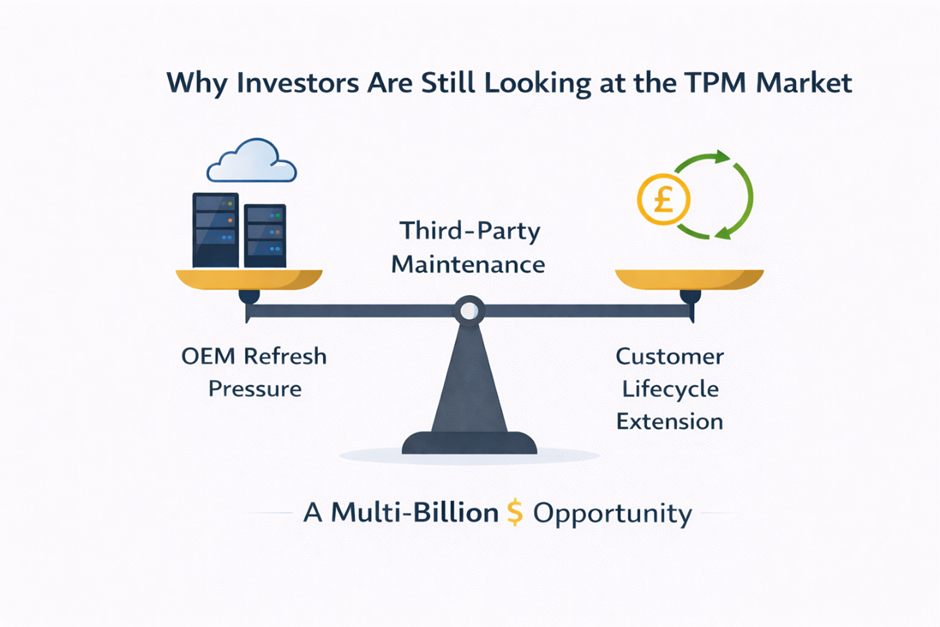
Lifecycle pressure and refresh strategy
Original equipment manufacturers naturally focus on selling the next generation of hardware platforms.
As infrastructure ages, maintenance pricing often increases and customers are encouraged to consider refresh programmes.
However, many enterprise systems remain technically stable and operationally effective long after OEM support models begin to push towards replacement.
For organisations looking to control costs and maximise return on capital investments, extending the life of these platforms can be an attractive option.
Customer choice
The persistence of the TPM market ultimately comes down to customer choice.
Many organisations prefer to retain flexibility in how they manage infrastructure lifecycles. Third-party maintenance provides an alternative support model that allows customers to align infrastructure decisions with their own operational and financial priorities.
A market shaped by competing forces
The relationship between OEM strategies, customer priorities and independent support providers has shaped the TPM industry for decades.
Understanding how these dynamics interact across different technologies, vendors and customer environments is often critical when evaluating the sector.
Over the past several years we have supported investors, advisory firms and four of the Big Five consulting organisations looking to better understand these dynamics when assessing opportunities in the TPM market.
Final thought
The TPM industry continues to exist not simply because it is cheaper.
It exists because many organisations want flexibility, control and choice when managing the lifecycle of their infrastructure.
Understanding how those priorities interact with vendor strategies is often where the real insight into the sector begins.
About the Author

Chris Smith
Chris Smith is a Non-Executive Director and commercial advisor with over 30 years’ experience in IT services across managed services (MSP) and third-party maintenance (TPM). With a background in IBM hardware maintenance, he progressed from field engineer to Sales & Marketing Director, helping to create the foundations of Blue Chip Cloud, which became the largest IBM Power Cloud globally at the time. He played a key role in the sale of Blue Chip in 2021 and subsequently led commercial growth and integration initiatives within Service Express, including delivering significant managed services growth and strengthening revenue predictability. Chris now works with private equity-backed, investor-led and founder-owned IT services businesses, supporting growth, commercial strategy, integration and exit readiness. He is particularly focused on helping organisations improve revenue quality, margin discipline and scalable go-to-market execution across MSP and TPM models.
LinkedIn