The Gaming of Sales KPIs: When Dashboards Replace Discipline
22 December 2025 - 4 Minute Read
Sales organisations love dashboards. They love numbers even more. At some point in the last decade, KPI dashboards stopped being a tool for insight and became the measure of success. The result of this is a culture where people hit the metric but miss the point.
Nowhere is this more obvious than in sales.
When KPIs Become the Job, Not the Outcome
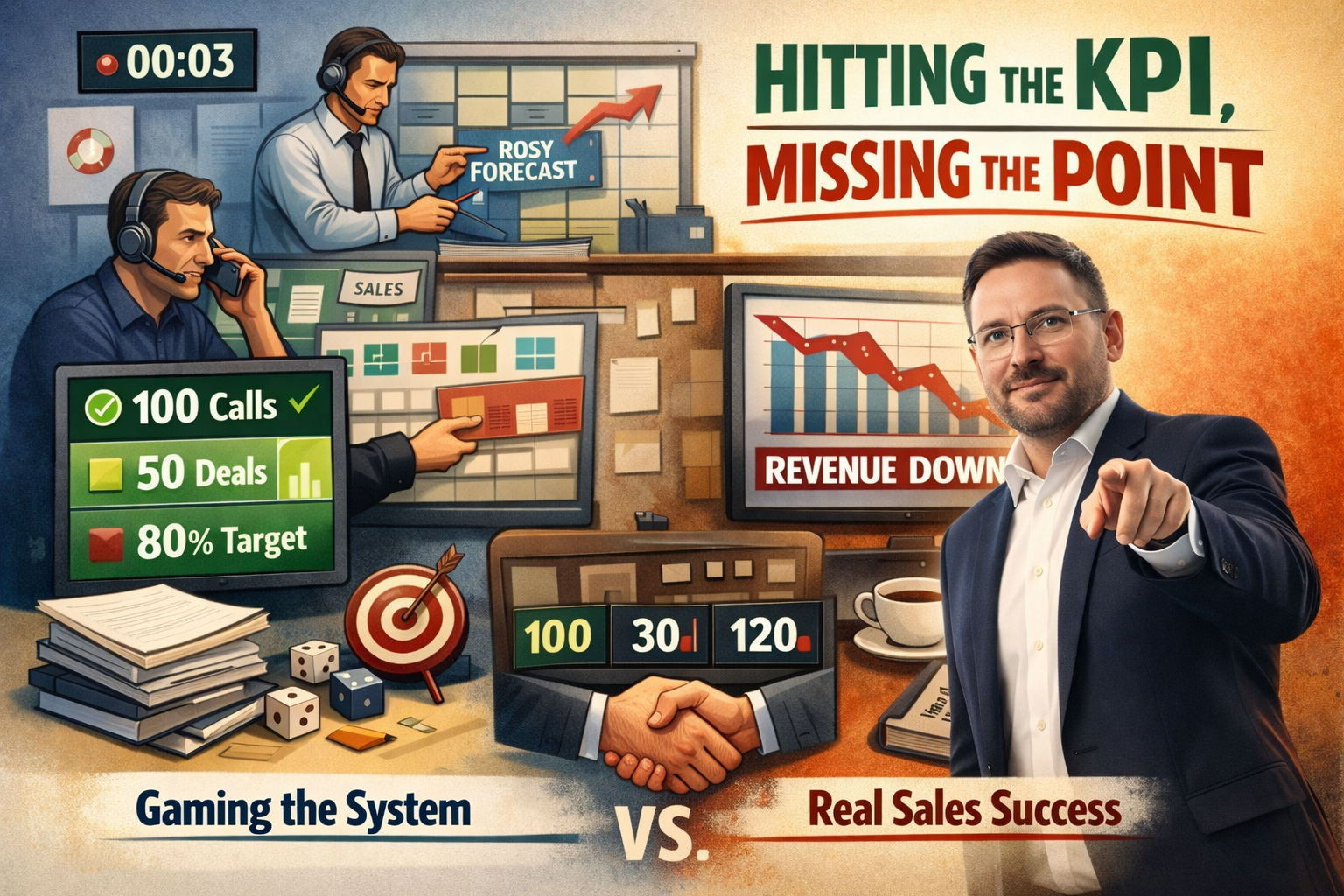
It starts innocently enough. An SDR is told to make 100 calls a day. Before long, they learn that hanging up after three seconds still counts as a call. They hit their KPI. The dashboard goes green. Everyone is happy, except the customer who was never truly called, and the business that received zero value. Then it moves up the chain.
An account manager needs a certain number of opportunities and meetings. So they create ghost pipeline entries or book meetings that aren’t real. As long as the CRM reflects the target, they’re safe. The culture doesn’t reward accuracy, it only rewards numbers.
A sales manager is fully aware this is happening. But their own KPIs depend on the team hitting theirs. By enforcing the metric, even when it is meaningless, they protect their own standing. And senior leadership? They push deals into later pipeline stages to inflate forecasts for the board, PE owners, or shareholders. “Confidence in the number” matters more than whether it reflects reality.
Cracked the Code?
Eventually, the organisation thinks it’s cracked the code: a perfect formula that predicts success. But the numbers don’t translate to outcomes. So the targets increase: 100 dials becomes 120. More headcount is added. More dashboards created. And the business owner is left wondering why this great mathematical model hasn’t produced results.
The answer is simple:
KPIs are not outcomes. And when they become the outcome, they will be gamed.
The Consequences of Managing by Dashboard Alone
When dashboards become the single source of truth, you create perverse incentives:
- Activity is rewarded over achievement
- Data quality collapses under pressure
- Pipeline becomes fiction, not forecast
- Experienced sellers who rely on skill, not vanity metrics, are punished
The irony is painful: the more a business focuses on hitting KPIs, the more disconnected it becomes from actual performance. You end up rewarding those who can game the system while frustrating those who deliver results without needing arbitrary activity targets.
And that’s before we address the management trend behind this shift. Somewhere along the way, we adopted a belief, driven by MBAs and large consultancies, that sales is a production line. That if you just instrument it with enough dashboards and track enough micro-activities, you can industrialise performance.
But you can’t. Sales is not manufacturing. It is a human conversation.
A Master of Business Administration is not the same as a Master of Sales. And dashboard governance rarely replaces real leadership.
What Actually Drives Sales
Sales has always been built on one thing: meeting with customers.
Not call counts.
Not pipeline volume.
Not artificial stage progression.
Not activity for activity’s sake.
Customer conversations create opportunities.
Opportunities create revenue.
Everything else is noise.
Dashboards have their place. They are useful for junior or early-career sales roles where discipline and rhythm must be learned. But when dashboards become the culture, when numbers matter more than truth you lose skill, judgement and integrity.
And eventually, you lose performance.
The Way Forward: Governance, Process, and Outcomes That Matter
The solution is not to abandon KPIs. It’s to restore their purpose.
Businesses need:
- Honest governance: Data must reflect reality, not ambition.
- Process reviews: What is being tracked and why?
- Outcome-driven management: Reward results, not artificial activity.
- Customer-centric focus: Conversations, relationships, and problem-solving.
- Leadership that understands sales not just dashboards.
You fix sales performance by improving the craft of selling, not by increasing the number of dashboard tiles.
Until we recognise this, organisations will continue to celebrate green KPIs while wondering why revenue is red.
Get Sales, Not Noise
At Baby Blue, we help organisations return to the grass roots of sales: real conversations, real opportunities, and real outcomes. For leadership teams and investors who need clarity in the numbers, we bring discipline back into the sales process and rebuild confidence in the data. KPIs should inform performance, not dictate behaviour. If you want to eliminate dashboard distortion, strengthen governance, and refocus your teams on what genuinely drives revenue, let’s talk. Baby Blue will help you redesign your sales operation so KPIs become a tool, not a rule, and your people can get back to doing what actually moves the number.
About the Author

Chris Smith
Chris Smith is a Non-Executive Director and commercial advisor with over 30 years’ experience in IT services across managed services (MSP) and third-party maintenance (TPM). With a background in IBM hardware maintenance, he progressed from field engineer to Sales & Marketing Director, helping to create the foundations of Blue Chip Cloud, which became the largest IBM Power Cloud globally at the time. He played a key role in the sale of Blue Chip in 2021 and subsequently led commercial growth and integration initiatives within Service Express, including delivering significant managed services growth and strengthening revenue predictability. Chris now works with private equity-backed, investor-led and founder-owned IT services businesses, supporting growth, commercial strategy, integration and exit readiness. He is particularly focused on helping organisations improve revenue quality, margin discipline and scalable go-to-market execution across MSP and TPM models.
LinkedIn