Good People, Bad Systems: Why the Overuse of KPIs Ultimately Holds Growing Companies Back
2 May 2025 - 7 Minute Read
If your KPIs are driving the wrong behaviour, it’s not the team that’s failing, it’s the system.
We’ve worked with dozens of high-growth businesses, and one pattern keeps repeating: good people start making strange decisions not because they’re bad at their jobs, but because they’re trapped in systems that haven’t kept pace with the scale or changing purpose of the organisation.
It’s easy to take it personally and blame individuals, the team, or even yourself. But more often than not, we’re looking at it the wrong way. Let me explain.
Never Attribute to Malice What Can Be Explained by… Incentives
Over the last year or so I have been thinking about Hanlon’s Razor - a simple but powerful mental model:
“Never attribute to malice that which is adequately explained by stupidity.”
It’s a helpful reminder that not everything is a conspiracy. Sometimes, people just get things wrong, particularly when they’re operating outside their experience or comfort zone.
And at an individual level, this still very much applies.
We frequently see capable people struggle when they’re brought into:
- New industries
- New technical domains
- New regulatory environments
- Or unfamiliar commercial models
In those situations, gaps in domain knowledge, misunderstanding of context, or misplaced assumptions can genuinely explain poor judgement without needing to assume bad intent. That’s human and it’s fixable through support, coaching, and time.
But Douglas W. Hubbard took Hanlon’s Razor a crucial step further:
“Never attribute to malice or stupidity that which can be explained by moderately rational individuals following incentives in a complex system.”
This is where the lens must shift because while Hanlon’s Razor may apply to individuals, it does not apply to entire organisations.
When you see repeated failure patterns across multiple teams, regions, or service lines, you are no longer looking at isolated mistakes or capability gaps. You are dealing with structural design failure, not human error.
Where This Becomes Most Dangerous: Mergers and Expansion
This distinction becomes critically important in mergers, acquisitions, and rapid expansion across new business lines and geographies.
Time and again, we see organisations acquire businesses with:
- Completely different delivery models
- Different customer expectations
- Different margin structures and risk profiles
- Different regulatory and operational constraints
Yet instead of redesigning the operating model to fit this new reality, the prevailing organisation attempts to retrofit every service line into the shape of its largest, most established core business.
The logic is familiar:
“This is how we’ve always scaled.”
But scale does not equal suitability.
What follows is entirely predictable:
- Core-service KPIs imposed on fundamentally different service lines
- Governance models built for one geography forced onto another
- Reporting structures optimised for board visibility rather than operational truth
- And dashboard-friendly ROI metrics overriding the real constraints of customer delivery
None of this is driven by stupidity.
None of it is driven by malice.
It is driven by moderately rational people applying the wrong success model to a context it was never designed for.
And at that point, the system itself becomes the primary source of dysfunction.
When Sales Logic Breaks Outside of Sales
As a sales leader, I’ve always looked at incentive plans through a simple lens:
the right incentive plan drives the right behaviour, which drives the right outcome.
But not every part of a business needs to be run like sales. And when a business enters new markets or acquires one with a different model, simply applying the same playbook often leads to friction or failure.
What worked in one function, size, or structure may not work in another.
Sales-style targets don’t translate well into every department or context. What starts as a good idea, clear metrics, growth targets, standardised KPIs, can quickly unravel when applied universally.
When Dashboard Culture Replaces Real Leadership
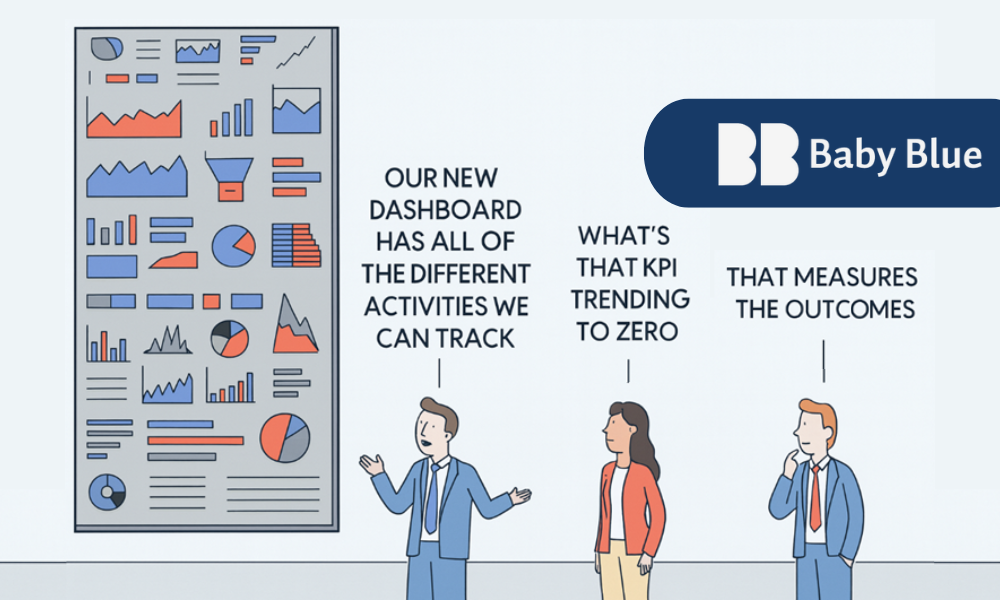
As companies scale, many leadership teams become increasingly reliant on dashboards to understand the health of the business. It’s efficient, convenient, and feels objective. But dashboard culture comes with a hidden cost: it distances leadership from reality.
ROI metrics and performance dashboards often become the primary lens for decision-making. The numbers look clean and definitive but what sits beneath them is messy, human, and interconnected. When leaders optimise for what the dashboard rewards, they inevitably deprioritise what the dashboard can’t see.
This creates three major issues:
1. Leaders Become Detached from the Front Line
Metrics become a substitute for real conversations with customers, engineers, service teams, and delivery. Insight is reduced to data points rather than understanding lived experience.
2. Interdependencies Are Ignored
Dashboards simplify complex, cross-functional work into isolated KPIs.
A decision that improves ROI in one area can quietly create failure demand, technical debt, customer frustration, or operational stress in another and the dashboard won’t show it until the damage is done.
3. ROI Trumps Customer Value
When people know they’re being measured on KPI movement, behaviour shifts.
Numbers become the goal.
Consequences - delayed delivery, increased risk, poorer experience all become secondary as long as the dashboard stays green.
This is where many growing organisations go wrong: the system optimises for metrics, not outcomes.
Rational People, Irrational Outcomes: 6 Real-World Examples
- Sales Teams Chasing Revenue Over Resilience
Short-term targets push high-revenue, low-margin deals through the pipeline. Ops struggle, profitability suffers, and long-term value is sacrificed. - Tech Teams Launching Unfinished Products
Release volumes are rewarded more than long-term quality. The result? Buggy MVPs, increased support load, frustrated customers. - Support Teams Under SLA Pressure
Measure closure speed, and tickets get closed quickly - not well. - Outsourced Services Hitting KPIs, Missing the Point
Third parties meet contractual numbers while missing the real-world outcome. - Organisations Obsessed with Measurement Over Meaning
M&A targets, cost caps, siloed priorities, all driven by metrics rather than shared success. - Entrenched Leadership Waiting for the Exit
In some PE-backed businesses, leaders manage to the pack, not to the mission. Compliance replaces stewardship.
What You Measure Shapes What You Get
Most dysfunction in growing companies doesn’t come from bad people.
It comes from capable people working within systems that reward the wrong things, often because those systems were designed for a different size, structure, or purpose.
As companies scale or shift direction, there’s a critical need to re-evaluate how work is measured and rewarded. Systems built for one context rarely succeed when forced onto another.
“In growing businesses, dysfunction often arises not from bad intent or incompetence, but from capable people trapped in systems, structures, and roles that no longer fit the scale or purpose of the organisation.” - The Scaling by Design Principle
This doesn’t just apply to size, it applies to what the business actually does. When the operating model evolves, so too must the way success is defined.
Assuming the old playbook still applies can quietly destroy the value you’ve worked hard to build.
If This Sounds Familiar…
At Baby Blue, we’ve seen first-hand how fast-growing businesses can find themselves trapped in legacy structures, rigid KPIs, and dashboard-led decision making. None of this is caused by bad people. It’s caused by systems that no longer fit the scale, complexity, or purpose of the organisation.
This is where Baby Blue can help.
We work with leadership teams to:
- Diagnose structural misalignment - incentives, KPIs, org design, operating rhythm, decision flows
- Map cross-functional dependencies and uncover unintended consequences
- Redesign measurement and governance models that support long-term value, not just short-term scores
- Build operating frameworks that scale with growth, acquisition, and service complexity
- Reconnect leaders to reality by bringing customer, delivery, engineering, commercial and service insight back into decision-making
Our approach is practical, evidence-based, and built on decades of experience scaling infrastructure, managed services, and cloud organisations.
The outcome isn’t just better reporting.
It’s better alignment, better decisions, and ultimately, a business that grows because the system, not just the people, is set up to succeed.
If you’re scaling fast, integrating acquisitions, entering new markets, or dealing with unexplained friction in performance and delivery, it might not be the team at all.
It might be the system. And fixing it is what we do.
Let’s have a conversation. Book a 30 minute meeting - no pressure, no commitments, just expert insight to agree & guide your next steps.
About the Author

Chris Smith
Chris Smith is a Non-Executive Director and commercial advisor with over 30 years’ experience in IT services across managed services (MSP) and third-party maintenance (TPM). With a background in IBM hardware maintenance, he progressed from field engineer to Sales & Marketing Director, helping to create the foundations of Blue Chip Cloud, which became the largest IBM Power Cloud globally at the time. He played a key role in the sale of Blue Chip in 2021 and subsequently led commercial growth and integration initiatives within Service Express, including delivering significant managed services growth and strengthening revenue predictability. Chris now works with private equity-backed, investor-led and founder-owned IT services businesses, supporting growth, commercial strategy, integration and exit readiness. He is particularly focused on helping organisations improve revenue quality, margin discipline and scalable go-to-market execution across MSP and TPM models.
LinkedIn