“End of Standard Service” for IBM POWER9: Clarity Over Confusion
14 May 2025 - 4 Minute Read
A guide on IBM’s announcement and what it means for your estate
There has been a surge of posts recently, particularly from third-party maintenance providers, suggesting that IBM POWER9 is reaching “End of Service Life” and that organisations must act urgently to avoid risk. As someone who has worked across IBM hardware engineering, maintenance, and managed services for more than three decades, I want to offer a clearer, more grounded view of what IBM has actually announced and what it means in practice.
What IBM has announced
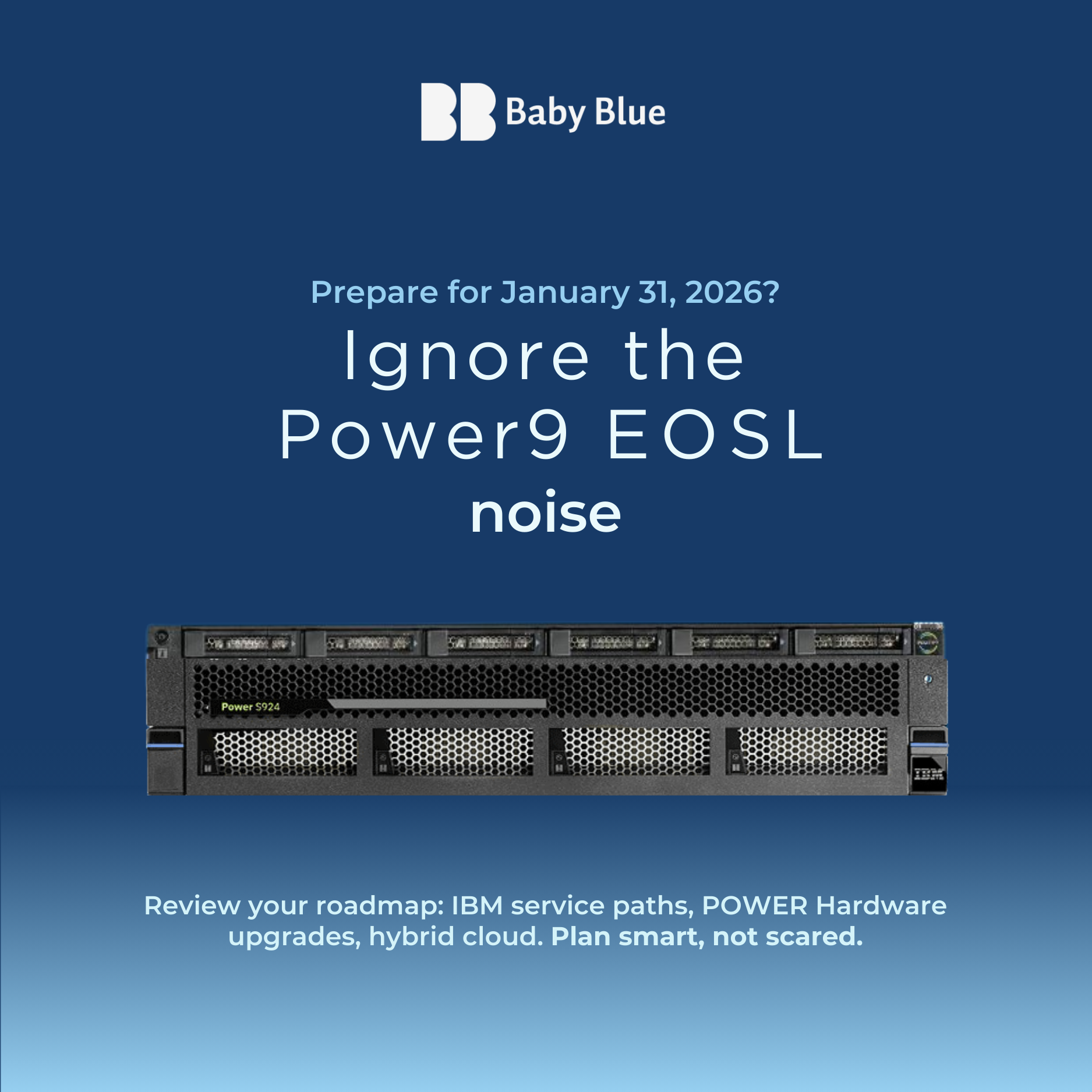
IBM has confirmed that selected POWER9 models will reach End of Standard Service (EOSS) on 31 January 2026.
IBM’s statement makes three things clear:
- EOSS applies only to “standard service” - meaning IBM will no longer provide preventive service, new fixes, machine code updates or new security patches for the affected POWER9 systems after that date.
- Existing valid maintenance agreements continue - contracts remain honoured until their expiry. The change is that renewal under IBM’s standard Hardware Maintenance Agreement (HWMA) will not be available for the listed systems beyond the EOSS date.
- IBM may offer service extensions - customers can, in some cases, purchase extended maintenance beyond EOSS, but this is handled separately from standard service offerings.
In short: these systems are not suddenly unsupported, nor do they become non-functional. The announcement marks a standard lifecycle milestone, not an immediate operational risk.
Why some narratives feel alarmist
Much of the commentary circulating online frames POWER9 as “end of life” or “unsupported”, often implying urgent refresh decisions. While EOSS is a meaningful stage, it is not the same as an immediate withdrawal of all service options.
Statements that conflate EOSS with “the system will soon be unusable” miss the nuance, and in some cases, risk misleading organisations who need a measured, commercially sound plan rather than reactive decisions.
The reality: EOSS is a planning milestone, not a crisis
1. Your system will continue to run
POWER9 hardware and operating environments remain fully operational beyond the EOSS date. There is no automatic discontinuation of functionality.
2. You retain control of your risk and timing
EOSS simply means you should assess your lifecycle roadmap. It doesn’t mean you must refresh immediately or take dramatic action. You have time to plan sensibly.
3. Support choices remain
You can:
- Continue under existing IBM maintenance until contract expiry
- Explore IBM extension options
- Assess alternative support models
- Plan an orderly upgrade to POWER10 or POWER11 when the business case aligns
EOSS doesn’t remove your ability to choose, it simply marks the point where the support model shifts.
Practical steps I advise clients to take
- Identify exactly which POWER9 models you operate
Not all POWER9 systems are included. Validate your machine type/model against IBM’s announcement. - Check your current firmware, OS levels and maintenance commitments
Understanding your platform’s technical baseline is essential for informed decision-making. - Evaluate business and application dependencies
Focus on performance, availability, compliance, security and workload sensitivity. - Review the cost–value trade-off of your support options
OEM support, extension routes or alternative models each come with different technical and commercial considerations. - Build a phased timeline
The 31 January 2026 date should inform your planning horizon, not dictate immediate change. Map out 6-, 12- and 18-month touchpoints. - Communicate with stakeholders
Explain the lifecycle position clearly, without drama. A well-articulated plan builds trust and ensures no “surprises” down the line.
Closing thoughts
EOSS for IBM POWER9 is an important lifecycle event but it is not an emergency. It does not mean systems are obsolete overnight, and it does not diminish the many organisations successfully running core workloads on POWER9 today.
What it does do is create a natural moment to review your strategy, assess your support model, and plan your next steps on your terms, not under pressure from alarmist interpretations.
If you’d like help shaping a clear, customer-ready communication for your organisation, or want a version tailored to your MSP or TPM audience, I’d be happy to support.
Speak to Baby Blue
If you value impartial, experience-led guidance on:
🔹 IBM maintenance options
🔹 Planning upgrades to POWER10 or POWER11
🔹 Exploring cloud or hybrid solutions for IBM Power Systems
…Baby Blue can help you navigate your choices with clarity and confidence.
Feel free to reach out for an honest conversation about what’s right for your environment.
About the Author

Chris Smith
Chris Smith is a Non-Executive Director and commercial advisor with over 30 years’ experience in IT services across managed services (MSP) and third-party maintenance (TPM). With a background in IBM hardware maintenance, he progressed from field engineer to Sales & Marketing Director, helping to create the foundations of Blue Chip Cloud, which became the largest IBM Power Cloud globally at the time. He played a key role in the sale of Blue Chip in 2021 and subsequently led commercial growth and integration initiatives within Service Express, including delivering significant managed services growth and strengthening revenue predictability. Chris now works with private equity-backed, investor-led and founder-owned IT services businesses, supporting growth, commercial strategy, integration and exit readiness. He is particularly focused on helping organisations improve revenue quality, margin discipline and scalable go-to-market execution across MSP and TPM models.
LinkedIn