Don't Let an IBM End of Support Announcement Force You into an Unnecessary Hardware Upgrade
28 July 2026 - 5 Minute Read
IBM End of Life & End of Standard Support: What IBM Power Customers Need to Know
If you've been told your IBM Power server or IBM operating system has reached End of Life (EOL), it's easy to assume your only option is to buy a new server.
For many organisations, that's exactly the conclusion they're encouraged to reach.
The reality is often very different.
A support announcement shouldn't force a purchasing decision. It should be the point at which you review your options.
IBM EOL vs IBM EOSS – What's the Difference?
For many years IBM hardware and software lifecycle announcements were commonly referred to as End of Life (EOL).
Although IBM now generally uses the term End of Standard Support (EOSS), most customers still search for "IBM End of Life", and many IBM Business Partners and maintenance providers continue to use the older terminology.
Unfortunately, this can create the impression that an "End of Life" announcement means your only option is to replace your server.
It doesn't.
For many IBM Power products, reaching End of Standard Support simply means the standard support period has ended.
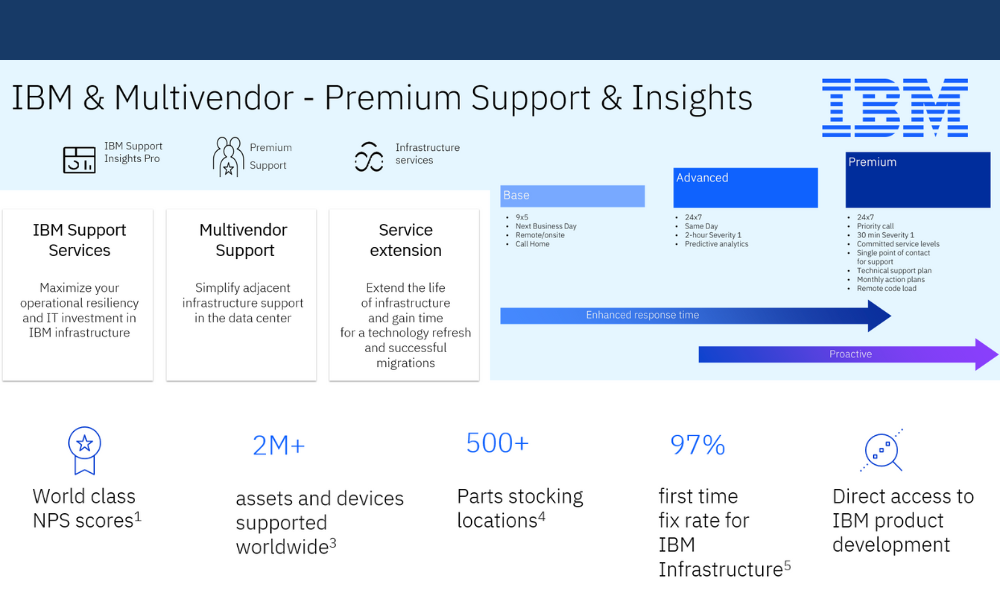
IBM often provides Extended Support, allowing customers to continue receiving IBM support beyond the EOSS date while they plan their next move. The cost is typically higher than standard IBM Hardware Maintenance (HWMA) and Software Maintenance (SWMA), but it provides valuable breathing space for organisations that aren't ready to upgrade immediately.
The important message is simple:
End of Standard Support isn't the end of your options.
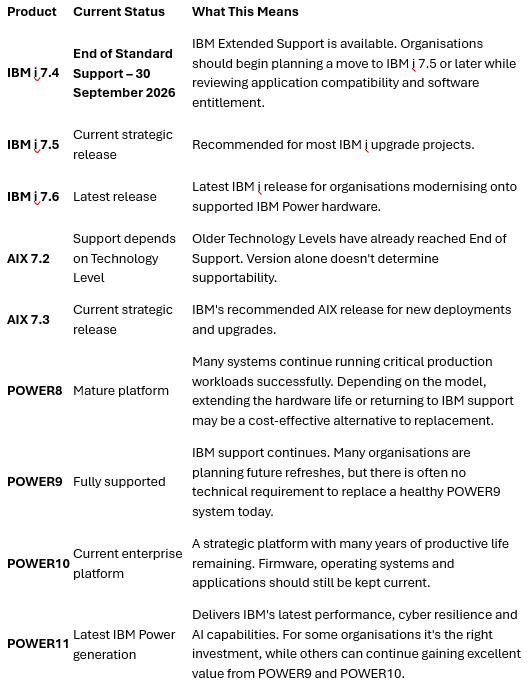
Current IBM Power Lifecycle
Below is a summary of the current position for common IBM Power hardware and operating system releases.
End of Support Doesn't Always Mean You Need New Hardware
Replacing the server isn't always the answer.
In many cases the biggest challenges aren't the hardware at all.
Application Licensing
Many IBM i applications remain licensed against the physical server serial number.
Replacing hardware can mean:
- Purchasing new application licences.
- Paying transfer fees.
- Negotiating with software vendors.
- Discovering the original supplier no longer exists.
Sometimes the software licensing becomes the biggest obstacle, not the server itself.
Operating System Compatibility
Many business-critical applications have never been certified on newer IBM i or AIX releases.
This leaves organisations caught between three competing pressures:
- Ageing hardware.
- Operating systems approaching End of Standard Support.
- Application vendors unwilling to certify newer operating system releases.
Buying new hardware doesn't solve any of those issues on its own.
Lost IBM Entitlement
This is one of the most common situations we see.
IBM maintenance may have been cancelled years ago to reduce costs, or the server may have been covered by a third-party maintenance provider.
Everything works perfectly until it's time to upgrade.
Only then do organisations discover they no longer have entitlement to:
- Download newer IBM i or AIX releases.
- Download firmware and machine code.
- Access IBM PTFs and software updates.
- Transfer IBM software licences.
- Move IBM operating system licences to replacement hardware.
Many customers assume they've reached a dead end.
In reality, there is often a route forward.
A Typical Customer Scenario
A customer approached Baby Blue believing they needed to replace their IBM Power server because an IBM support milestone was approaching.
Initially, a hardware refresh appeared to be the obvious answer.
However, after reviewing the environment we identified several hidden challenges.
The organisation had:
- IBM Hardware and Software Maintenance that had lapsed several years earlier.
- Lost entitlement to download the latest IBM i operating system.
- Applications licensed against the existing server serial number.
- Application compatibility concerns with newer IBM i releases.
- Firmware, HMC and supporting infrastructure that also required attention.
Rather than recommending an immediate hardware replacement, we developed a phased roadmap.
This included:
- Reviewing IBM support entitlement.
- Planning a route back onto IBM Hardware and Software Maintenance.
- Regaining access to IBM operating system upgrades.
- Identifying application and licensing risks before migration.
- Creating a staged upgrade plan aligned to both operational requirements and budget.
The result was a significantly lower-risk project, a clearer understanding of the available options and an upgrade strategy driven by business priorities, not support deadlines.
Every IBM Power environment is different, but the lesson is the same: an End of Standard Support announcement should be the start of a conversation, not the end of your choices.
Hardware Is Only One Piece of the Puzzle
Before investing in any IBM Power refresh, organisations should review far more than the server itself.
A successful upgrade should also consider:
- IBM Hardware Maintenance (HWMA)
- IBM Software Maintenance (SWMA)
- IBM i or AIX operating system entitlement
- Firmware and machine code
- HMC levels
- SAN and storage firmware
- Backup software compatibility
- High Availability replication
- Third-party software certification
- Applications licensed against IBM serial numbers
We've seen projects delayed by months because these dependencies weren't identified until after replacement hardware had already been ordered.
Before You Buy New, Speak to Baby Blue
Whether you're running POWER8, POWER9, POWER10 or planning for POWER11, we'll help you understand every available option before you invest.
Sometimes a new IBM Power server is absolutely the right decision.
Sometimes extending the life of your existing infrastructure, returning to IBM Hardware and Software Maintenance or resolving software entitlement challenges delivers a significantly better commercial outcome.
Baby Blue can help you:
- Extend the life of IBM Power hardware.
- Return to IBM Hardware Maintenance (HWMA).
- Reinstate IBM Software Maintenance (SWMA).
- Regain entitlement to IBM i and AIX upgrades.
- Plan firmware, HMC and storage upgrades.
- Develop a phased hardware and operating system roadmap.
- Migrate to newer IBM Power platforms when the time is right.
Don't let an IBM End of Support announcement dictate your strategy.
Before you invest in new IBM Power hardware, speak to Baby Blue. We'll help you understand every available option, maximise the value of your existing investment and upgrade when the time is right for your business, not simply because a lifecycle date has arrived.
About the Author

Will Nicholls
Will Nicholls is an industry recognised expert in the field of Hardware & Software Maintenance services especially around all IBM platforms. Will has worked in this field as a salesman for over 25 years and in his time has won some of the largest third party maintenance contracts many of which, due to his passion for account management, stayed with him for multiple years. Will is known for his innovation, bringing new, highly profitable services to the organisations he worked for. Will is now responsible all things maintenance related and making sure that we always do the right thing for the Customer.
LinkedIn