Cisco UCS Support: Understanding the Maintenance Options
16 March 2026 - 3 Minute Read
Cisco UCS: A Platform That Sits Between Servers and Networking
Cisco UCS sits in an interesting place in the data centre.
It’s a server platform, but because of the way Cisco designed the architecture, it behaves differently when it comes to support and lifecycle management.
Over the years I’ve seen many organisations struggle with the same question:
Should UCS be supported like traditional servers or like Cisco networking infrastructure?
The answer is rarely straightforward.
Over the years I’ve seen organisations take very different approaches, often depending on who is advising them.
Cisco OEM Support for UCS
Cisco provides UCS support through Smart Net Total Care and Solution Support contracts.
These typically include:
- hardware replacement
- access to Cisco TAC
- firmware and software updates
- support for UCS Manager and integrated platform features
Because UCS tightly integrates networking and compute, many organisations retain OEM support where environments rely heavily on:
- firmware consistency
- automated provisioning
- integrated networking capabilities
For newer platforms or complex deployments, OEM support is often the lowest-risk option.
Third-Party Maintenance for UCS
As UCS platforms mature, organisations often explore third-party maintenance (TPM) as a way to reduce support costs.
Many TPM providers can support:
- UCS rack servers
- blade servers
- certain fabric interconnect hardware
Once systems reach later stages of their lifecycle and the environment is stable, TPM can deliver reliable hardware support at a significantly lower cost than OEM contracts.
However, TPM providers cannot offer Cisco TAC access or full firmware entitlement, which can still be important in some environments.
The Challenge With Support Advice
One of the challenges organisations face when reviewing support options is that the advice they receive often comes from companies with a clear commercial interest in one model.
OEM vendors will naturally promote their own support services.
Third-party maintenance providers tend to focus on the services they can deliver. In many cases they have little incentive to recommend OEM support, as reselling vendor contracts typically offers very limited margin compared with their own maintenance services.
As a result, organisations are often presented with one perspective or the other, rather than a balanced assessment of the options.
A Hybrid Support Strategy
In practice, the most effective approach is often a hybrid support strategy.
For example:
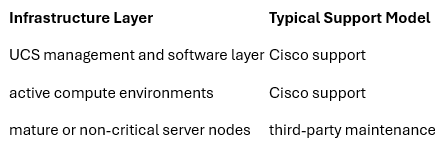
This allows organisations to maintain OEM support where it adds operational value, while optimising the cost of supporting mature infrastructure.
Independent Advice on UCS Support
At Baby Blue IT Consulting, our role is not to sell maintenance contracts or promote a particular support model.
Instead, we help organisations evaluate their infrastructure support strategy across servers, storage and networking, advising on the most appropriate combination of:
- OEM support
- authorised partner support
- third-party maintenance providers
Because we take an independent view, our focus is simply what works best for the customer’s environment; balancing risk, operational requirements and cost.
For organisations running Cisco UCS platforms, this often means building a support strategy that evolves as the infrastructure matures.
About the Author

Chris Smith
Chris Smith is a Non-Executive Director and commercial advisor with over 30 years’ experience in IT services across managed services (MSP) and third-party maintenance (TPM). With a background in IBM hardware maintenance, he progressed from field engineer to Sales & Marketing Director, helping to create the foundations of Blue Chip Cloud, which became the largest IBM Power Cloud globally at the time. He played a key role in the sale of Blue Chip in 2021 and subsequently led commercial growth and integration initiatives within Service Express, including delivering significant managed services growth and strengthening revenue predictability. Chris now works with private equity-backed, investor-led and founder-owned IT services businesses, supporting growth, commercial strategy, integration and exit readiness. He is particularly focused on helping organisations improve revenue quality, margin discipline and scalable go-to-market execution across MSP and TPM models.
LinkedIn